Rafael Alves Martins
Project 2
Importance of Soccer in an Economy
Introduction
The value of sporting activities in our today’s society today can never be underestimated. It contributes to the growth of the country’s economy through foreign exchange earnings. Soccer is one of the sports that is making huge positive impacts on society. Notably, soccer is the world’s most popular game as it has huge followership in terms of fans. Soccer teams and player foundations are raising funds for worthy functions. Significant events are boosting local and international economies for the betterment of society. Thus, below is a discussion about the impacts of soccer on the economy from a small scale to a large scale perspective.
Impacts Of Soccer To The Economy
Soccer has impacted the economy on a small scale in terms of the team’s proceeds from the sport. First, soccer acts as a source of employment to various individuals in the teams (Agha & Rascher, 2016). Many soccer players, coaches, referees, football club owners, among others, rely on soccer as their ultimate breadwinner. Profits obtained from ticket sales part of the revenue used to compensate the mentioned individuals. Moreover, profits obtained from the sale of the merchandise are also used in the team’s maintenance. The merchandise sold includes various player jerseys, signed soccer balls by celebrity players, hats, among others (Dolci et al., 2018).
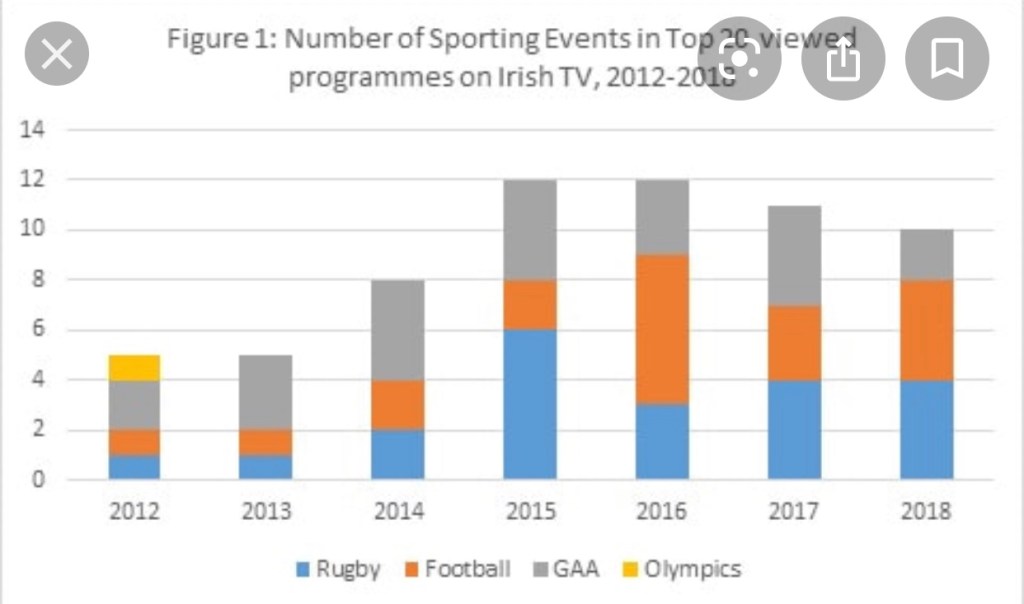
Graphic showing the number of Sportive events on Irish Tv
Secondly, various teams are allowed to make transfers of players. During the transfers, most of the teams score big in revenue as they tend to sell the best players to the highest bidder regardless of the league (Coates & Jewell, 2016). Also, most teams own their stadiums where they get to play the home matches. Revenue generated from the sale of the players can thus be used in the development and maintenance of the football stadiums in terms of repairs and paints. Generally, in areas where the various individual stadiums reside, the economy is appraised. The economy is appraised in that during the various home matches, many visitors support their teams, and they have to pay for accommodations, food, and other social amenities.
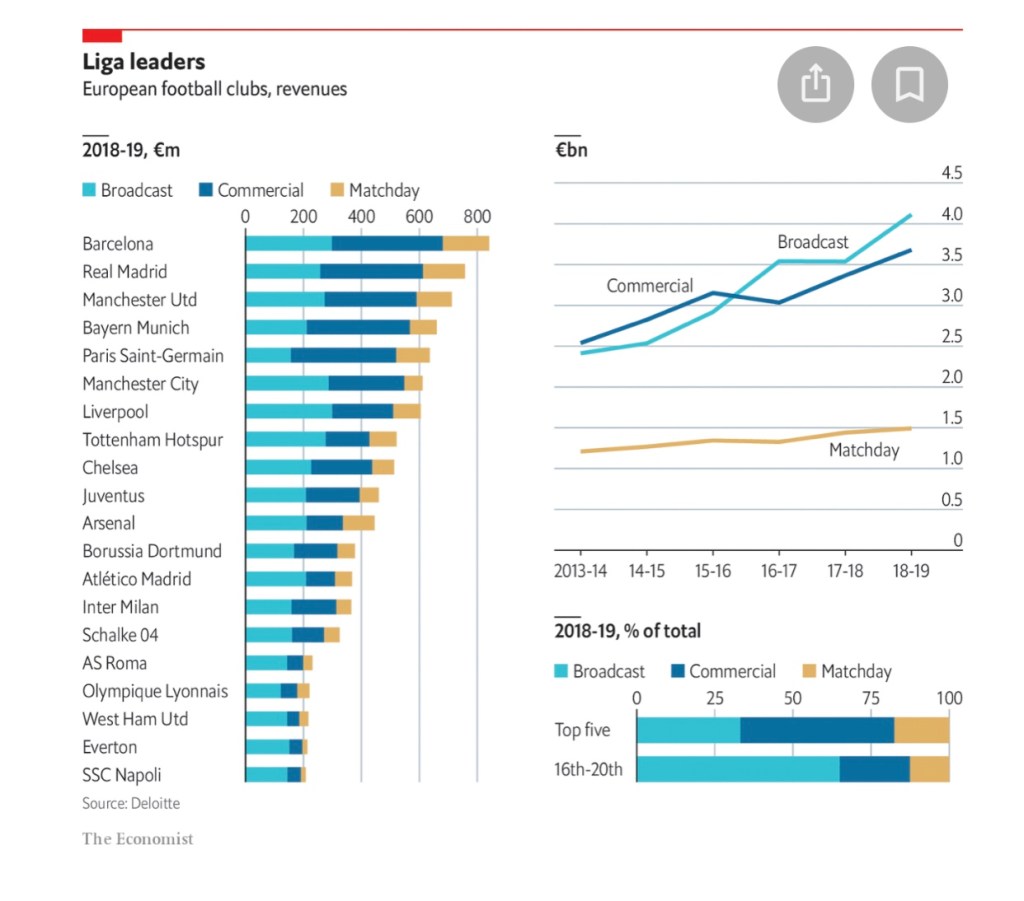
This graphic shows the different revenues of the richest soccer clubs
Global Economics Impacts of Soccer
Soccer has also impacted the global economy from a large-scale perspective. Global soccer is a multi-billion enterprise and is presided by FIFA. FIFA currently has 209 member states, and just like the United Nations or the African Union, it distributes funds to its members in the form of grants. Each country that is a member of FIFA receives an annual sum of money depending on the profits garnered that year through the Financial Assistance Program. For instance, the member states were allocated a bonus of 500,000 US Dollars from the proceeds obtained from the 2014 World Cup (Maennig, 2017). Also, the organization loans the member states with funds to fund soccer-related projects, thus, in turn, boosting the economy of these nations.
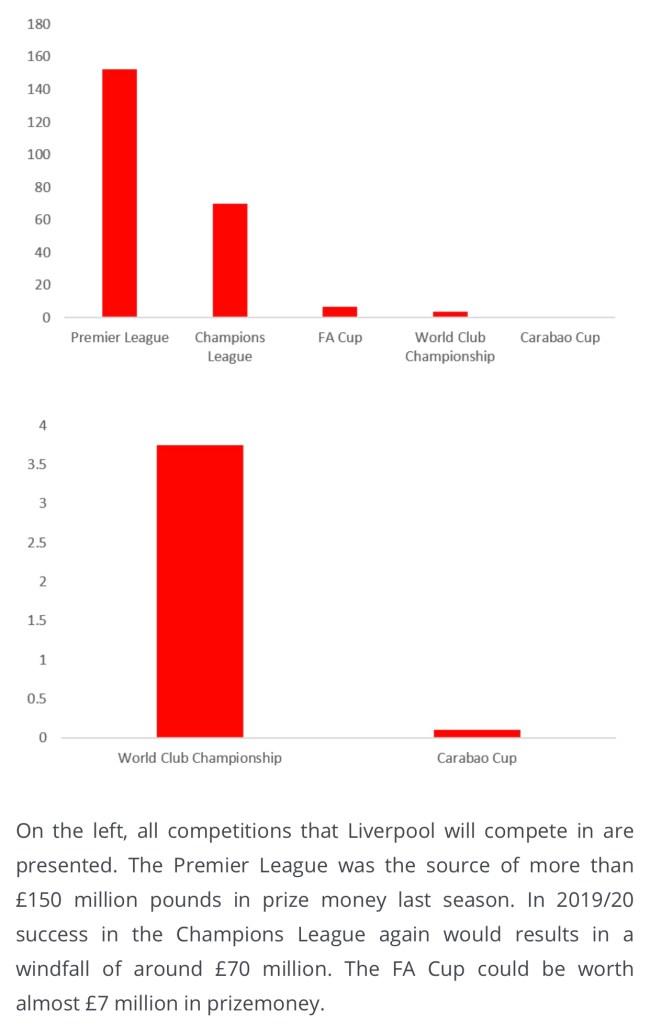
World Cup, which is the primary tournament of FIFA, has grown over the past decades. It has become one of the biggest cash cows for the organization. For instance, during the World Cup hosted in Brazil, FIFA generated more than 5 billion US Dollars in the form of revenue (Maennig, 2017). Seventy percent came from ticket sales, merchandise sales, and television rights to air the matches (Maennig, 2017). According to statistics, FIFA currently holds more than 1.5 billion US Dollars in their reserves (Maennig, 2017). This huge amount of money made by the organization is used in the development of several projects, such as the construction of soccer stadiums and other infrastructure globally.
FIFA has also employed very many people globally. Most technical people during matches such as referees are normally compensated by this organization, thus creating employment opportunities. This is a form of growth for the economy. Additionally, the world provides massive revenues to FIFA, but it also tremendously boosts the host country’s economy. The tournament tends to impact the host’s economy positively. For instance, during the 2011-2014 world cup cycle hosted in Brazil, more than thirteen million jobs were created in the country (Demir & Rigoni, 2017). Many Brazilians benefited from the event as they secured employment opportunities and were able to scale their economy to better heights compared to before the tournament. World cup attendance during that period in Brazil was more than 3.4 million from all over the world. Thus, these fans brought in billions in the form of revenue to Brazil’s economy in terms of the money they paid to cater to their accommodation, traveling, and food expenses. Moreover, other organizations, such as betting sites, have profited from soccer massively.
Betting is another income source for soccer. Many people globally participate in gambling and tend to place numerous bets on the various soccer teams playing against each other (Feng & Humphreys, 2018). The taxes collected from the betting sites by the various governments are channeled into developing other crucial sectors (Demir & Rigoni, 2017). Also, the betting sites tend to sponsor the various soccer clubs from the proceeds obtained, participate in charitable events as ways of giving back to the society and in the process boosting the economy.
Conclusion
Soccer is an important aspect of the economy in many nations. Soccer has provided several job opportunities, injected massive amounts of money into both local and global economies, and it should not come as a surprise that we should encourage, nurture and promote the playing soccer for its numerous benefits.
References
Agha, N., & Rascher, D. A. (2016). An explanation of economic impact: Why positive impacts can exist for smaller sports. Sport, Business, and Management: An International Journal.
Coates, D., Frick, B., & Jewell, T. (2016). Superstar salaries and soccer success: The impact of designated players in Major League Soccer. Journal of Sports Economics, 17(7), 716-735.
Dolci, F., Hart, N. H., Kilding, A., Chivers, P., Piggott, B., & Spiteri, T. (2018). Movement economy in soccer: Current data and limitations. Sports, 6(4), 124.
Demir, E., & Rigoni, U. (2017). You lose, I feel better: Rivalry between soccer teams and the impact of schadenfreude on the stock market. Journal of Sports Economics, 18(1), 58-76.
Feng, X., & Humphreys, B. (2018). Assessing the economic impact of sports facilities on residential property values: A spatial hedonic approach. Journal of Sports Economics, 19(2), 188-210.
Maennig, W. (2017). Major sports events: Economic impact. Hamburg Contemporary Economic Discussions, (58).

 Site Title